
Scarcity is everything to a brand in the world of luxury where too much availability can lead to a loss of prestige. Behind that scarcity is often the idea that an item is rare because careful attention went into making it. This was a lesson dior learned the hard way when it started licensing its name in the 1950s. Renting out the brand to third parties meant a wide range of products from ties, stocking, hats, handbags and more would be stamped with the name of this world famous fashion house. This strategy was highly profitable at first as Dior would make money every time its name was printed on an item without having to produce a thing. However, selling more can feel like selling out when it comes to luxury. Scaling in this industry risks cheapening the brand and pushing away the people who made it desirable in the first place. In the case of Dior, too many licenses led to products being made at wildly different levels of quality. With counterfeit products also flooding the market, the brand became diluted as it lost its exclusivity by the time the group filed for bankruptcy in 1978.
And yet, LVMH turned scale into strength to become the most successful luxury business of all time. It has built an empire by stacking brands, including Dior, across continents and product categories while maintaining exclusivity. The group has pulled this off by turning the forces that usually dilute a luxury brand into a system that reinforces prestige.
The Power of Scale and Scope
Bigger companies are able to spread their fixed costs across more units to drive down what each item costs to make. This is economies of scale in action and it’s a powerful way to turn size into a competitive advantage. It’s the formula behind Amazon’s dominance which started off by selling books online and grew by reinvesting in scale to become the giant business it is today. Its size allows it to negotiate lower prices with suppliers and spread the high fixed costs of logistics and automation across millions of orders, making each item cheaper to sell. Smaller companies struggle to keep up because they often rely on outsourced or shared production, which limits their control over quality and slows down their operations. Even when these small companies run their own factories, low volumes can mean higher costs through underused capacity.
Economies of scope on the other hand explains how costs can be lowered by sharing operations across different products. Amazon does this by using the same warehouses and delivery networks to offer everything from books and electronics to clothing and groceries. Spreading resources like this means new categories can be launched quickly to respond to changing market environments. Single product companies struggle to compete because new products means building new supply chains and teams from scratch while Amazon reuses what it already has. The result is a business that gets more efficient with every product it sells and every category it enters. While this strategy works almost everywhere else, it can run into wall when it comes to luxury.
The Luxury Paradox
The problem with economies of scale in the luxury industry is that scale undermines the stories these products draw their power from. One of those is the story of good craftsmanship where something is made slowly by skilled hands and attention is paid to every detail. It creates the sense that it wasn’t made for just anyone. Mass production and standardised processes erase this feeling of specialness. The emphasis on efficiency strips away the intentional, handcrafted process that gives luxury goods their value. Economies of scope can feel more intuitive in this space because of the promise of growth through variety rather than volume, but they carry the same risk. When a brand tries to be everything at once, it can lose the clarity and focus that made it special. Economies of scale depend on volume and economies of scope on variety, but luxury sells meaning.
Take the example of Burberry, who licensed its name and distinctive check pattern to help expand production and distribution into new markets. Sales initially took off but the brand was now on everything from dog collars to baseball bats. By the 2000s, the brand was overexposed and was no longer considered luxury as its original customers were moving elsewhere.
Then there’s the high-end fashion house Pierre Cardin, who in the 1960s successfully extended into perfume and cosmetics. Aimed at reaching new customers and markets, it seemed like a smart growth strategy, with scaled production lowering costs and expanding reach. However, the company made the mistake of attributing this success to its brand and not the categories it extended into being a good product fit. The label began appearing on everything from bicycles, lighters and even kitchenware. The sheer volume of products diluted the prestige of the original label and confused consumers. The strategy may have increased visibility, but it came at the cost of the brand’s identity, a mistake LVMH managed to avoid.
Breaking the Rules
Every brand has the independence to shape its own products and control how it presents itself to the world but behind the scenes, LVMH pools its immense buying power to negotiate better terms. This balance is what allows the group to benefit from scale without compromising exclusivity. When it comes to advertising, each brand creates their own campaigns but as a collection, LVMH can buy media in bulk to secure discounts a single brand couldn’t. Publishers are more inclined to give these discounts as the group represents a partner that can replace dozens of small deals with one large and predictable revenue stream. This balancing act also drives retail deals where each brand retains creative control of the stores but LVMH negotiates as a group for the properties. They receive favourable terms as they can fill multiple vacancies at once for their family of brands while a standalone competitor negotiates for one storefront at a time.
 Reference: LVMH Annual Reports
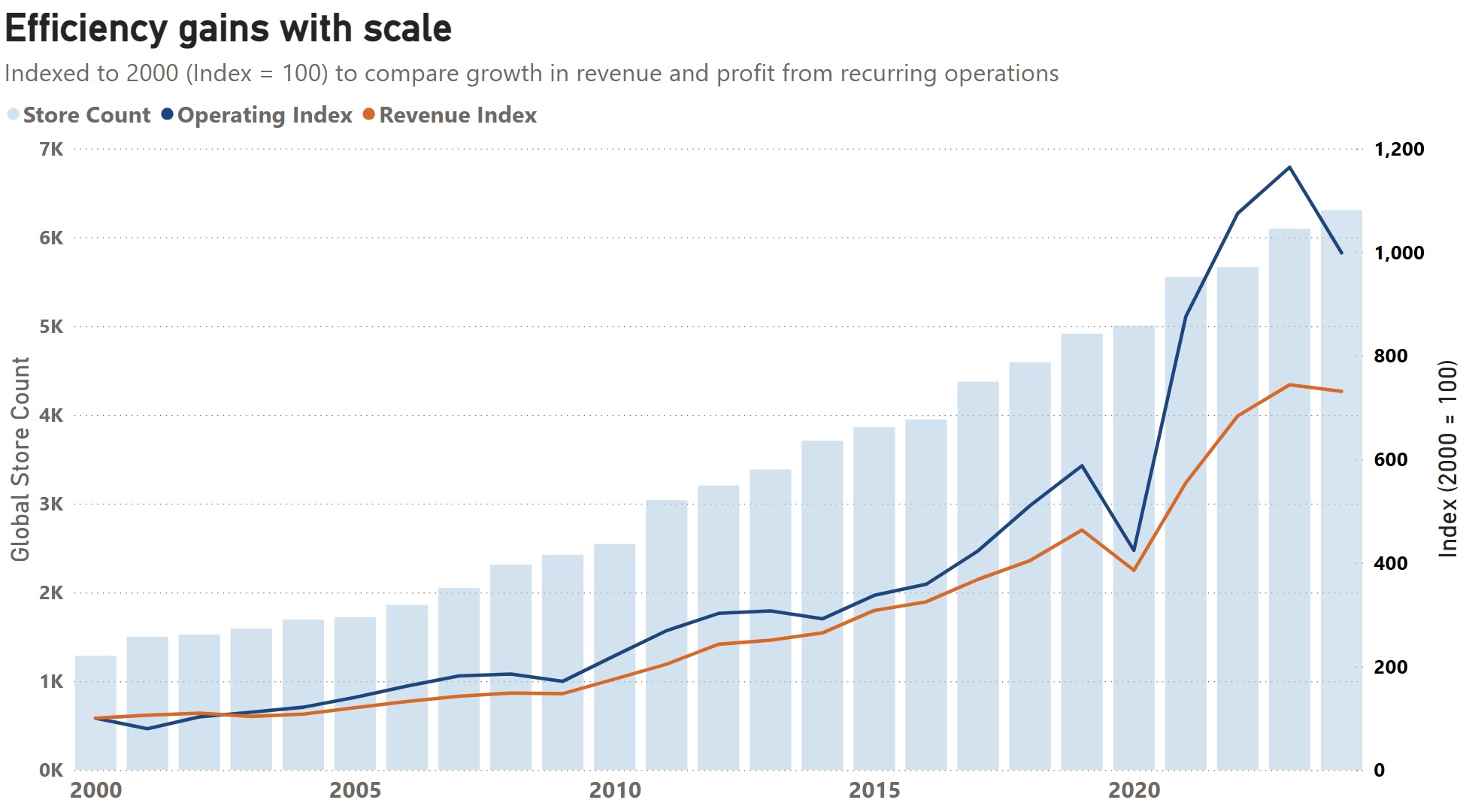
As LVMH scales, both revenue and operating profit have grown substantially but the growth in operating profit has been more pronounced since 2000. This points to greater efficiency as the group spreads costs across a wider store network. Each new store has added more to the bottom line than it costs to operate, strengthening the advantages of scale while keeping the uniqueness of each brand intact.
Reference: LVMH Annual Reports
As LVMH scales, both revenue and operating profit have grown substantially but the growth in operating profit has been more pronounced since 2000. This points to greater efficiency as the group spreads costs across a wider store network. Each new store has added more to the bottom line than it costs to operate, strengthening the advantages of scale while keeping the uniqueness of each brand intact.
Another way LVMH gets ahead is by letting its brands share resources and systems to cut cuts. Dior can use the same supply chain expertise that moves Hennessy around the world and different brands might also travel together during delivery. However, they maintain complete separation in customer-facing environments. The company allows employees to make career moves between different brands as a way to move up the corporate ladder, sharing best practices and operational expertise along the way. But the designers have complete control over their creations with no interference from management. This strategic approach is what allows the group to maximise synergies while preserving each brand’s identity.
 Reference: LVMH Annual Reports
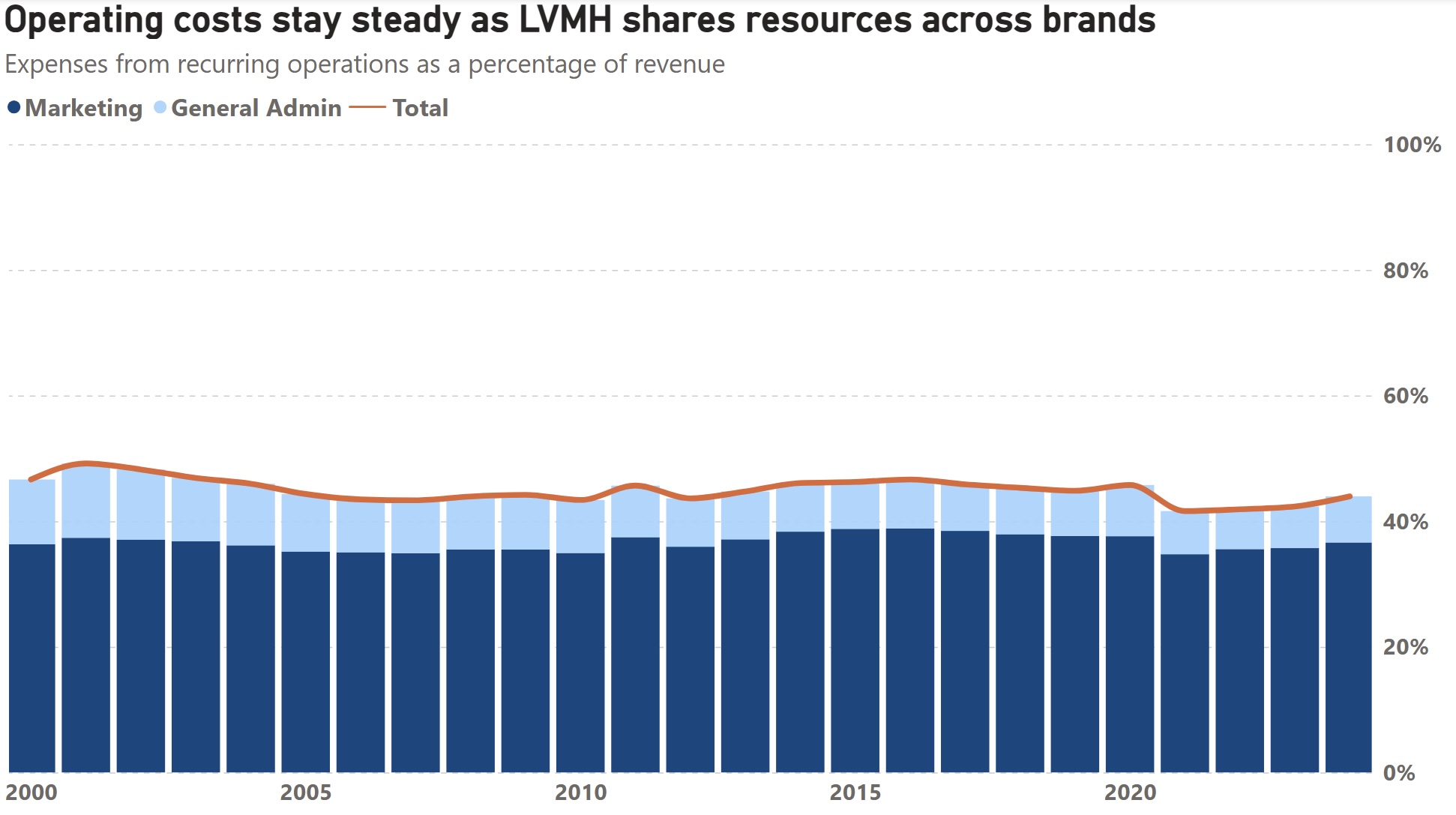
Operating costs have held steady for more than two decades even as LVMH has continued adding brands and expanded to thousands of new stores worldwide. Marketing expenses account for a larger share of costs than administrative expenses but both categories have remained stable over time. Together, this consistency has kept the overall amount steady at 40-45% of revenue.
Reference: LVMH Annual Reports
Operating costs have held steady for more than two decades even as LVMH has continued adding brands and expanded to thousands of new stores worldwide. Marketing expenses account for a larger share of costs than administrative expenses but both categories have remained stable over time. Together, this consistency has kept the overall amount steady at 40-45% of revenue.
 Reference: LVMH Annual Reports
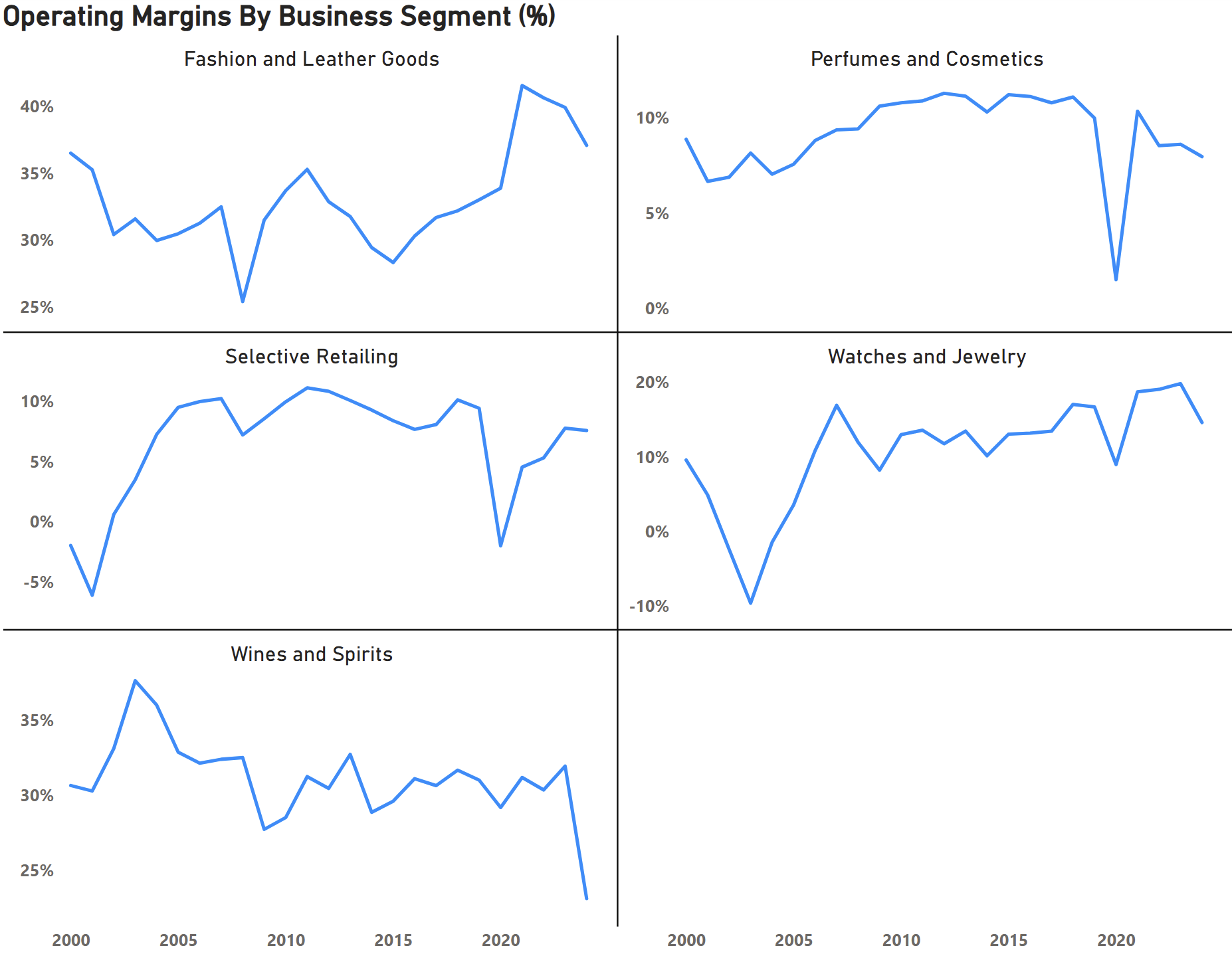
At the same time, the individual business groups have become more profitable. Fashion and leather goods rose from about 35% operating margin in 2000 to more than 40% at its peak. Watches and jewelry and Selective Retailing both moved from losses to steady margins of around 15% and 7% respectively. Even Perfumes & Cosmetics edged higher in its 6–11% range. The only exception is wines and spirits which has faced recent troubles.
Reference: LVMH Annual Reports
At the same time, the individual business groups have become more profitable. Fashion and leather goods rose from about 35% operating margin in 2000 to more than 40% at its peak. Watches and jewelry and Selective Retailing both moved from losses to steady margins of around 15% and 7% respectively. Even Perfumes & Cosmetics edged higher in its 6–11% range. The only exception is wines and spirits which has faced recent troubles.
LVMH also owns more of what goes into making its products. The group’s vertical integration strategy transforms what could be a liability into its greatest competitive moat. Louis Vitton for example controls about 60% of its supply chain, from leather sourcing to final production. Dior is rapidly accelerating its own vertical integration after recent supply chain scandals. This level of control allows the brands to maintain their quality standards. LVMH’s scale allows it to build and operate tanneries and manufacturing facilities because it spreads these large fixed costs across dozens of brands. A single luxury brand can struggle to justify the large capital expenditure, but for LVMH one tannery can produce leather used by multiple brands. This has created a reinforcing cycle where scale leads to greater control and greater control protects the craftsmanship stories that luxury depends on. LVMH has turned costly specialised manufacturing from a burden into an advantage that grows stronger as more brands are added.
Growth Without Dilution
Luxury brands walk a fine line where growth promises new markets and higher revenues but it can also erode the scarcity that makes these products desirable in the first place. LVMH has avoided this trap by designing a system where scale, scope and vertical integration reinforce each other. Scale lowers costs and builds bargaining power. Scope spreads those efficiencies across categories. Vertical integration ensures quality stays intact. Together they have created a cycle where growth brings greater control and this greater control is used to protect exclusivity. It is this balance that has allowed LVMH to become the world’s largest luxury group while keeping the qualities that make its products special.